
Articles & Market Insights
Packaging & Logistics
November 22, 2026 · 9 min read
Bitumen Export Packaging Guide: Jumbo Bags (1 MT / 300 kg) vs. Steel Drums vs. Bitutainers
Beroil Trade Desk
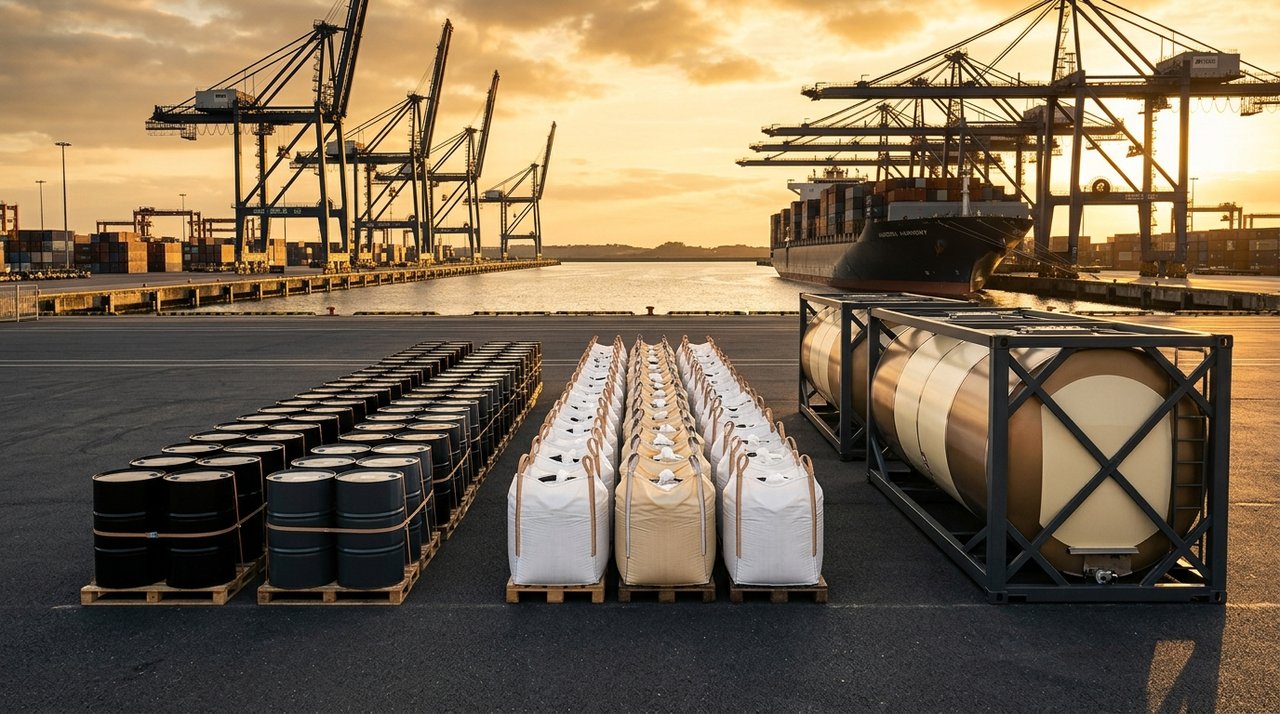
Packaging accounts for 12% to 28% of the landed CFR price of exported bitumen—and choosing the wrong containment format frequently creates bottlenecks worse than freight rate spikes. From 180 kg new steel drums and meltable 300 kg / 1 MT polybags to heated ISO Bitutainers, procurement teams must weigh 20ft container payload economics, hot-mix decanting efficiency, environmental drum disposal laws, and multi-modal inland durability before locking in an export contract.
1. New Steel Drums (150 kg / 180 kg / 190 kg): Maximum Rough-Terrain Resilience
Cold-rolled steel drums remain the universal workhorse for exported Penetration 60/70, VG30, and cutback bitumens moving into remote infrastructure zones lacking forklift pads or closed hot-oil melting boilers. Standard 0.6 mm embossed steel barrels hold 180 kg net weight (gross ~191 kg), allowing 110 palletized or unpalletized drums—approximately 19.8 metric tons—to be stuffed inside a single 20-foot dry shipping container without exceeding standard road weight ceilings.
Steel drums tolerate multi-stage transshipment, coastal rain exposure, crane slings, and unheated open-yard storage in equatorial heat above 45°C without bulging or rupturing seams. Smaller 150 kg thick-gauge drums are also widely specified for remote mountain projects in East Africa and Central Asia where manual crew unloading replaces mechanical handlers.
The trade-offs are steel tare cost, decanting loss, and scrap liability. When decanted via diesel-fired or thermal-oil drum melters at the asphalt plant, 2% to 4% residual binder commonly clings to interior walls unless slow inverted heating cycles are maintained. Strict environmental authorities in Europe, East Africa, and South Asia also levy growing disposal fees on empty bitumen-coated steel barrels.
2. Meltable Jumbo Bags & Polybags (300 kg & 1,000 kg): Zero Wastage & Higher Container Payloads
Two-layer flexible bitumen bags—manufactured in 300 kg and 1 MT (1,000 kg) capacities—combine a UV-stabilized woven polypropylene (PP) outer lifting shell with a specialized inner polyethylene/polyolefin film liner engineered to melt cleanly around 110°C–125°C without altering binder penetration or viscosity. Once the outer PP sling bag is sliced and peeled away at the asphalt batching site, the inner wrapped bitumen block drops directly into the melter tank, achieving near-zero binder residue.
From a pure maritime freight standpoint, 1 MT jumbo bags or strapped 300 kg polybag cages load 20 to 24 metric tons into a standard 20-foot dry container depending on destination port road-weight limits—lifting net payload by 10% to 20% over drums while cutting empty packaging tare costs significantly.
However, jumbo bags impose strict thermal and storage discipline. Standard 60/70 and VG30 viscosity bitumen packed in polybags must be cooled adequately before container stuffing, protected inside ventilated yards away from direct summer sun above 45°C, and lifted smoothly via intact top loops. Soft high-penetration grades like 80/100 or liquid cutbacks (MC-30 / MC-70) cannot safely be packed in jumbo bags and must always move in tight-head steel drums or tanks.
3. Heated ISO Bitutainers (24–27 MT): Continuous Liquid Logistics for High-Volume Plants
For Tier-1 contractors operating high-output 160–320 TPH asphalt plants near deepwater container ports, 20-foot insulated ISO Bitutainers provide an uninterrupted hot-liquid supply chain. Holding 24 to 27 metric tons per tank—with stainless internal flame-tube diesel burners or dual thermal-oil/electric heating coils wrapped in 100 mm mineral wool insulation—Bitutainers travel on standard container ships at ambient solidified temperature and reheat on site to 150°C–170°C within 12–18 hours.
Eliminating drum cutters and solid-block melter queues drastically cuts site labor and fuel consumption while protecting binder rheology from accidental localized scorching. Bitutainers also command maximum payload efficiency per sea slot when empty return logistics are properly scheduled.
The limiting constraint for Bitutainers is round-trip fleet management and container detention/demurrage exposure. Because specialized tank operators charge daily lease rates after free port days expire, projects located more than 400 km inland or facing slow customs clearance often see demurrage charges wipe out all packaging savings compared to one-way steel drums or jumbo bags.
4. Matching Packaging Format to Climate, Grade & Port Corridor
Successful bitumen buyers match containment not solely on FOB drum vs. jumbo-bag price spread, but on total destination plant readiness. High-softening-point grades such as Oxidized Bitumen 115/15 or 90/15 solidify into clean brittle slabs, making 25 kg or 50 kg meltable polybags and carton boxes exceptionally efficient for roofing and waterproofing factories. Conversely, high-traffic port corridors in Mombasa, Dar es Salaam, Djibouti, Mundra, or Chattogram require balancing port-clearance speed against highway crane availability.
When consolidating mixed petrochemical shipments out of Jebel Ali—pairing paving binders alongside our main bitumen export specifications, bulk fertilizers, or industrial alkalis—standardized 20ft FCL containerization in 1 MT jumbo bags or 180 kg drums simplifies customs manifests and port drayage. Reviewing our full export supply catalog and corporate logistics standards helps buyers structure repeatable monthly schedules without equipment bottlenecks.
5. Loading Supervision, Weight Verification & Contractual Risk Controls
Regardless of packaging format, export claims routinely stem from moisture trapped under jumbo-bag liners during filling (causing dangerous foaming when heated past 100°C at the asphalt plant) or under-filled drums weighed on uncalibrated scales. Buyers should mandate dry-bag filling verification, independent SGS or Intertek weighbridge checks, numbered container bolt seals, and documented photo tally sheets prior to sailing—confirming our technical grading benchmarks in the Bitumen 60/70 vs. VG30/VG40 engineering guide.
To structure your next FOB Jebel Ali or CFR shipment in new steel drums, 300 kg / 1 MT jumbo bags, or ISO Bitutainers, contact our commercial team directly via the Beroil Energy quotation desk with target tonnage, grade, and unloading equipment constraints.
Export Packaging Comparison: Operational & Freight Metrics
01.
180 kg New Steel Drums (20ft FCL: ~19.8 MT / 110 Drums)
Best for rough multi-modal trucking, open-yard equatorial storage, cutback MC-30/MC-70, and regions without jumbo-bag melters; carries 2–4% decanting heel loss and barrel disposal obligations.
02.
1 MT & 300 kg Jumbo Bags / Polybags (20ft FCL: ~20–24 MT)
Lowest freight cost per metric ton among one-way packages; meltable inner PE/polyolefin liner (melting point ~110–125°C) yields near-zero binder waste at modern hot-mix asphalt plants.
03.
Heated ISO Bitutainers (24–27 MT Net Payload)
Fastest site pumping turnaround via built-in diesel flame tubes or thermal-oil coils (up to 180°C), ideal near container ports with predictable customs clearance to avoid daily tank demurrage.
04.
Water-Free Filling & Foaming Prevention (< 0.1% Moisture)
Specifying covered, climate-protected pouring prevents trapped rainwater inside drums or jumbo-bag folds—eliminating hazardous steam boil-over inside 160°C HMA storage kettles.
05.
Verified Container Stuffing & SGS Seal Traceability
Independent load-port survey confirming drum gauge (0.6 mm), UV-stabilized PP FIBC loop integrity, weighbridge net tonnage, and sealed container numbers protects buyers from transit disputes.
Packaging Options & Supply Desk Links
Review available bitumen containment formats and related technical guides below:
- 1 MT / 300 kg Jumbo Bags & 180 kg Steel Drums: Export-ready Penetration 60/70, 80/100, VG30, and VG40 supply backed by batch SGS certification.
- Bitumen 60/70 vs. VG30 & VG40 Technical Guide: Select the right penetration or viscosity grade before finalizing your container packaging format.
- Industrial Commodity & Bulk Product Portfolio: Explore sulfur, urea 46%, soda ash, sodium bicarbonate, and caustic soda export specifications.
- About Beroil Energy Global Trade & Logistics: Learn about our sourcing terminals, inspection standards, and maritime export capabilities.
- Request Packaging-Specific CFR / FOB Quote: Get side-by-side landed pricing for steel drums, jumbo bags, or Bitutainers to your discharge port.
Frequently Asked Questions
How many tons of bitumen fit in a 20ft container in steel drums vs. jumbo bags?
A standard 20-foot FCL container typically carries 110 new steel drums of 180 kg (~19.8 metric tons net), whereas 1 MT or 300 kg jumbo bags pack tightly up to 20–24 metric tons net depending on destination port road-weight limits.
Does the inner liner of a bitumen jumbo bag contaminate the asphalt mix?
No, provided genuine low-melt polyolefin/polyethylene inner liners (melting around 110–125°C) are used and the heavy woven polypropylene outer bag with lifting straps is removed before charging the melter.
When are ISO Bitutainers cheaper than steel drums?
ISO Bitutainers become more economical for continuous high-tonnage highway projects close to container ports where customs clears rapidly within free days, avoiding drum-melting fuel/labor losses and empty barrel disposal charges.
Can Bitumen 80/100 or Cutback MC-30 be exported in jumbo bags?
No. Soft penetration grade 80/100 softens too easily in warm containers and liquid cutback MC-30/MC-70 contains flammable kerosene solvent; both must ship in sealed new steel drums or certified tank containers.
Why does moisture inside bitumen packaging cause danger at asphalt plants?
Trapped water inside a drum or polybag fold turns instantaneously into high-pressure steam when submerged in 150–160°C molten bitumen, triggering violent foam-over hazards in plant decanting kettles.
Category
Latest Posts
Industrial Supply
November 22, 2026
Granular vs. Lump vs. Powder Sulfur: Industrial Uses, Technical Specs & Commercial Export Guide

Product Science
November 22, 2026
Polymer Modified Bitumen (PMB) & Bitumen Emulsions (CRS-2, CSS-1): Heavy-Axle & Cold Paving Engineering

Global Markets
November 22, 2026
How to Audit a Bitumen COA & SGS Report: ASTM D5, D36, Spot Test & B2B Export Procurement Checklist
Recent Posts
Practical chemical specifications, bulk packaging protocols, and commodity supply insights from Beroil Energy Group.
Industrial Supply
November 22, 2026
Oxidized Bitumen 115/15 and 90/15: Softening Point Engineering for Waterproofing, Roofing & Pipe Coating
Technical Research
November 22, 2026
Cutback Bitumen MC-30 vs. MC-70: Prime Coat Selection, Curing Rates, and Sub-Base Penetration

Technical Research
November 22, 2026