
Articles & Market Insights
Technical Research
November 22, 2026 · 9 min read
Cutback Bitumen MC-30 vs. MC-70: Prime Coat Selection, Curing Rates, and Sub-Base Penetration
Beroil Trade Desk
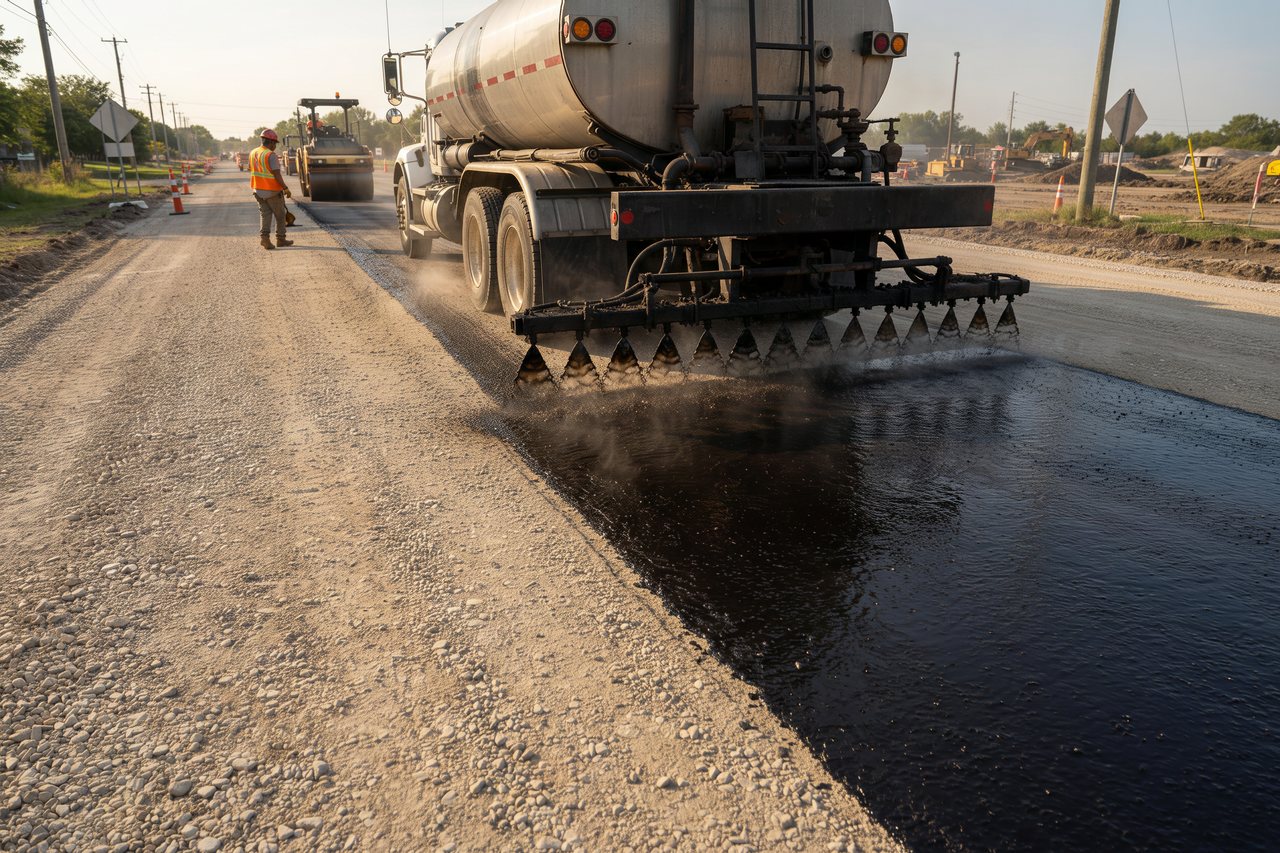
Structural premature delamination between crushed aggregate road bases and overlying hot-mix asphalt (HMA) wearing courses rarely stems from paving bitumen failure—it starts when an improper prime coat fails to wet dust films and knit upper aggregate voids together. Medium Curing (MC) Cutback Bitumen MC-30 and MC-70 dissolve refinery penetration binder in calibrated kerosene cutters so liquid binder penetrates cold granular bases cleanly before volatile evaporation restores full structural bond.
1. How Medium Curing (MC) Cutback Bitumen Works vs. Rapid (RC) & Slow (SC) Grades
Solid road binders like Penetration 60/70 or Viscosity VG30 freeze almost instantaneously on contact with cool, dusty crushed stone base courses, pooling as a brittle surface skin rather than wicking 5–10 mm down into inter-particle capillaries. Blending virgin penetration bitumen with petroleum distillates temporarily lowers viscosity so distributor spray bars atomize binder uniformly at mild heating temperatures (50°C–95°C).
Cutback families are categorized by solvent volatility under ASTM D2026, D2027, and D2028: Rapid Curing (RC-70 / RC-250) uses high-volatility naphtha/gasoline for fast tack coats and surface dressing; Medium Curing (MC-30 / MC-70 / MC-250) uses medium-volatility kerosene tailored specifically to absorb deep into compacted unbound bases; and Slow Curing (SC) uses low-volatility gas-oil distillates for dust suppression and cold stockpiled patching mixes.
The numeric designation in MC-30 or MC-70 indicates the minimum kinematic viscosity in centistokes (cSt) measured at 60°C under ASTM D2170—meaning MC-30 flows at roughly half the initial thickness of MC-70 and carries a higher percentage of kerosene cutter (typically ~42%–48% distillate by volume versus ~32%–38% in MC-70). Both families sit alongside our straight-run and oxidized lines in our Bitumen supply catalog.
2. MC-30 vs. MC-70 Technical Comparison: Viscosity, Cutter Ratio & Sub-Base Porosity
Under ASTM D2027, MC-30 must exhibit a kinematic viscosity between 30 and 60 cSt at 60°C, flash point (Tag Open Cup) minimum 38°C, water content maximum 0.2%, and yield a minimum 50% distillation residue by volume at 360°C with residue penetration between 120 and 250 dmm at 25°C. Because MC-30 is markedly fluid, it is the gold-standard prime coat for tightly compacted, dense-graded crushed aggregate (wet-mix macadam / GSB) with low surface void porosity.
MC-70 spans 70 to 140 cSt kinematic viscosity at 60°C, minimum 38°C flash point, and leaves at least 55% residual binder after distillation to 360°C. With lower kerosene content and higher film build, MC-70 bridges slightly coarser, open-textured granular bases, stabilized laterite soils, or weathered gravel shoulders where ultra-thin MC-30 would drain too rapidly below the upper 15 mm locking zone without leaving enough residual bitumen to bind surface fines.
Choosing incorrectly creates immediate field defects: spraying MC-70 onto a tightly rolled dense limestone base causes black surface puddling that turns slick under haul trucks, whereas spraying thin MC-30 over open-graded coarse crushed stone starves the interface bond unless spray volume is heavily increased.
3. Spray Application Temperatures, Nozzle Calibration & Curing Windows
Because cutback bitumen contains volatile kerosene, distributor tank temperatures must remain strictly controlled—higher heat improves spray fan uniformity, but overheating past flash limits risks vapor ignition inside truck domes. Typical distributor spraying windows run 50°C–70°C for MC-30 (never exceeding 75°C) and 60°C–85°C for MC-70 (maximum ~90°C), calibrated carefully against aggregate moisture and ambient wind speed.
Typical highway prime coat application rates range between 0.6 and 1.2 L/m2 depending on base permeability, verified via ASTM D2995 tray testing ahead of the paver. After spraying, the road section must remain closed to construction traffic for 24 to 72 hours so kerosene evaporates completely into the atmosphere; laying hot asphalt prematurely traps volatile solvent underneath the mat, causing blistering, flushing, and severe slippage cracking under braking loads.
On dusty quarry bases, pre-dampening slightly with a fine water mist—just enough to leave the surface damp without free standing water—breaks surface dust tension and helps MC-30 or MC-70 wick uniformly rather than balling up in loose fines.
4. Cutback Bitumen vs. Asphalt Emulsions (CSS-1 / CMS-2) in Export Projects
While urban projects in Europe and North America increasingly mandate water-based cationic emulsions to curb VOC solvent emissions, Medium Curing cutbacks (MC-30 and MC-70) remain indispensable across Africa, the Middle East, South Asia, and remote mountainous corridors. Unlike emulsions—which contain 35%–40% water, break irreversibly if frozen or agitated roughly over long transit, and sit uselessly once shelf-life separates—cutback bitumen remains stable indefinitely inside sealed steel drums.
Furthermore, dense, dusty calcareous bases common across Gulf and East African highways often repel water-based emulsions, causing skinning on top of dust layers. Kerosene-cut MC-30 dissolves thin bitumen films directly through dusty capillaries. Where projects also require high-heat waterproofing or structural enamel coatings alongside road priming, compare solvent-cut primers with blown binders in our Oxidized Bitumen 115/15 and 90/15 technical guide.
5. IMDG Class 3 Shipping, Closed Steel Drums & Export Inspection Protocol
Because MC-30 and MC-70 contain petroleum kerosene distillates (flash point ~38°C–50°C TOC), they are strictly regulated for sea freight under UN 1999 (Tars, liquid, including road oils and cutback bitumens) or flammable liquid IMDG Class 3 guidelines—never packable in jumbo bags or open polybags as explained in our Bitumen Export Packaging comparison. Export batches ship inside UN-certified tight-head (bung-type) new steel drums holding ~180 kg–200 kg net, palletized or choked cleanly inside 20-foot dry containers with Hazardous Goods Declarations (IMO DGD) and UN MSDS documentation.
To prevent cutter-stock shortages or off-spec viscosity upon arrival, buyers should require SGS/Intertek testing at loading covering ASTM D2170 kinematic viscosity at 60°C, ASTM D402 distillation curve at 225°C / 260°C / 315°C / 360°C, Tag Open Cup flash point (ASTM D3143), and water content (<= 0.2%). Review all available cutback and paving bitumen grades, explore our complete product catalog, or request IMO-compliant CFR drum pricing through our export quotation desk.
Engineering & Logistics Matrix: MC-30 vs. MC-70
01.
Kinematic Viscosity @ 60°C (ASTM D2170)
MC-30 flows at 30–60 cSt for dense, tightly rolled aggregate bases; MC-70 measures 70–140 cSt for slightly more open, porous granular or stabilized gravel sub-bases.
02.
Distillation Residue @ 360°C (ASTM D402)
MC-30 yields minimum 50% residual bitumen (higher ~45% kerosene cutter fraction), whereas MC-70 yields minimum 55% residual binder with faster curing.
03.
Distributor Spray Temperatures & Safety Ceiling
Spray MC-30 at 50°C–70°C (max 75°C) and MC-70 at 60°C–85°C (max 90°C) cleanly below flash-vapor ignition limits; never heat cutback in open-flame boilers.
04.
24–72 Hour Cure Before HMA Paving
Allow full kerosene evaporation prior to laying hot-mix asphalt to avoid trapped solvent blistering, binder flushing, and interlayer slippage cracking.
05.
UN-Certified Tight-Head Steel Drum & IMDG Class 3 Shipping
Unlike solid 60/70, liquid MC-30/MC-70 must move in sealed UN-certified bung steel drums accompanied by IMO Dangerous Goods Declarations and SGS distillation COA.
Cutback Bitumen Specifications & Export Links
Access technical resources and direct supply channels for highway priming and paving binders:
- Cutback Bitumen MC-30, MC-70, MC-250 & RC Grades: Exported in UN-certified tight-head steel drums with full ASTM D2027 SGS batch testing and IMO DGD.
- Bitumen 60/70 vs. VG30 & VG40 Paving Specs: Pair your primed aggregate sub-base with the right hot-mix penetration or viscosity wearing binder.
- Oxidized Bitumen 115/15 & 90/15 Waterproofing: Compare solvent-cut road primers with high-softening-point blown bitumen for membranes and pipes.
- Bitumen Drum vs. Jumbo Bag Export Packaging: Why liquid cutback and soft 80/100 require tight-head steel drums while solid 60/70 fits jumbo bags.
- Request IMO-Compliant MC-30 / MC-70 Quote: Send discharge port, grade, and drum quantity for complete FOB or CFR freight quotation.
Frequently Asked Questions
What is the main difference between Cutback Bitumen MC-30 and MC-70?
MC-30 has lower kinematic viscosity (30–60 cSt at 60°C) and a higher kerosene cutter ratio (~42–48%), allowing deeper capillary penetration into tight, dense-graded stone bases. MC-70 is thicker (70–140 cSt at 60°C) with more residual binder (>= 55%), suited to slightly coarser or more porous granular sub-bases.
How long must MC-30 or MC-70 prime coat cure before paving hot asphalt?
Depending on ambient temperature, wind, and aggregate density, prime coats typically require 24 to 72 hours for kerosene solvent to evaporate completely before laying hot-mix asphalt.
Why are MC-30 and MC-70 often preferred over asphalt emulsions in remote export markets?
Unlike water-based emulsions that can freeze, break during rough sea transit, or skin over dusty roads, cutback bitumen stays storage-stable in sealed steel drums and penetrates dusty calcareous bases effectively.
What temperature is safe for spraying MC-30 and MC-70 cutback bitumen?
Recommended distributor spraying temperatures are 50°C–70°C for MC-30 and 60°C–85°C for MC-70. Because cutback contains kerosene (flash point >= 38°C TOC), never use open-flame heating or exceed ~90°C.
How is MC-30 / MC-70 packaged for maritime export?
Liquid cutbacks are regulated as IMDG Class 3 flammable liquids (UN 1999) and must ship in sealed, UN-certified tight-head (bung) new steel drums—never in flexible jumbo bags.
Category
Latest Posts

Industrial Supply
November 22, 2026
Granular vs. Lump vs. Powder Sulfur: Industrial Uses, Technical Specs & Commercial Export Guide

Product Science
November 22, 2026
Polymer Modified Bitumen (PMB) & Bitumen Emulsions (CRS-2, CSS-1): Heavy-Axle & Cold Paving Engineering

Global Markets
November 22, 2026
How to Audit a Bitumen COA & SGS Report: ASTM D5, D36, Spot Test & B2B Export Procurement Checklist
Recent Posts
Practical chemical specifications, bulk packaging protocols, and commodity supply insights from Beroil Energy Group.
Industrial Supply
November 22, 2026
Oxidized Bitumen 115/15 and 90/15: Softening Point Engineering for Waterproofing, Roofing & Pipe Coating

Technical Research
November 22, 2026
Bitumen 60/70 vs. VG30 and VG40: Penetration vs. Viscosity Grading for Export Highway Projects

Packaging & Logistics
November 22, 2026