
Articles & Market Insights
Industrial Supply
November 22, 2026 · 9 min read
Oxidized Bitumen 115/15 and 90/15: Softening Point Engineering for Waterproofing, Roofing & Pipe Coating
Beroil Trade Desk
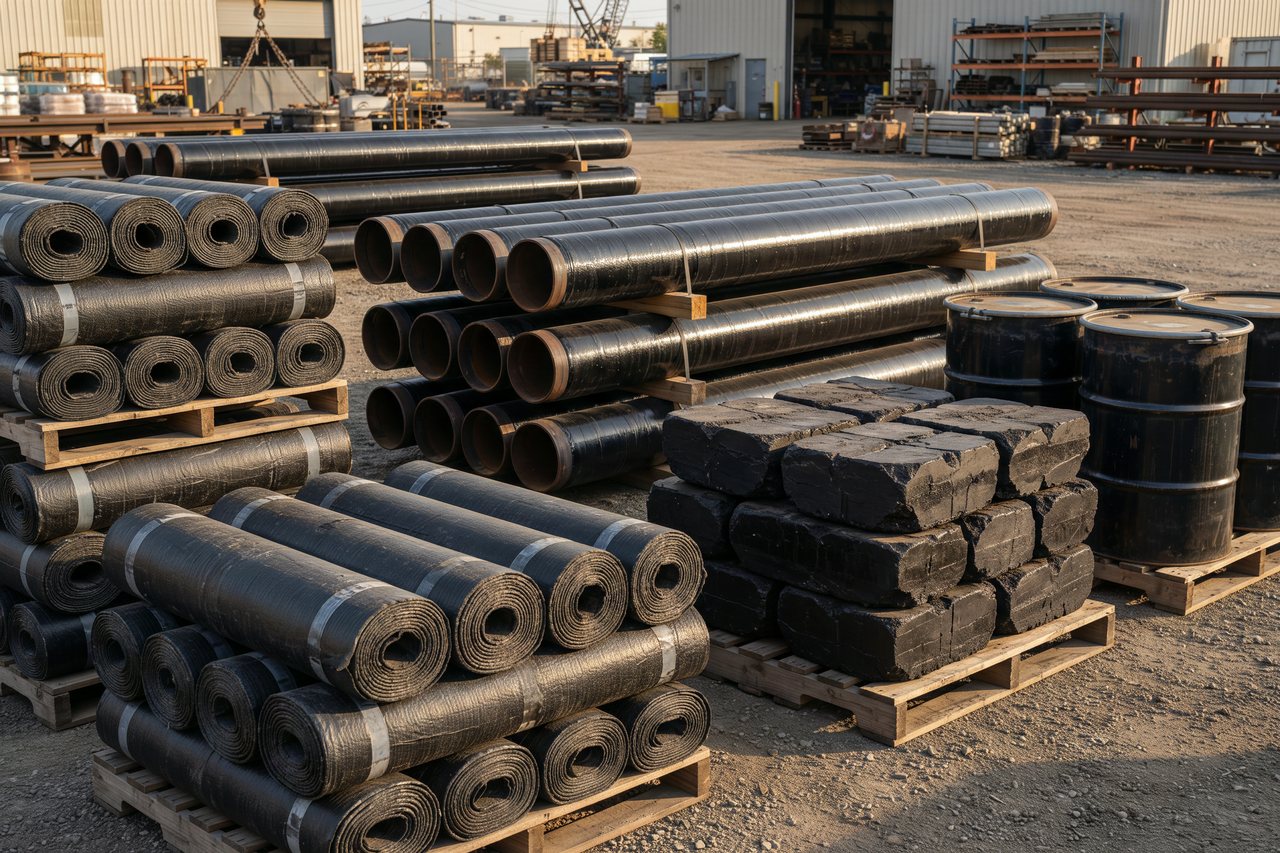
Unlike straight-run road paving binders designed to flow smoothly through hot-mix pugmills, industrial waterproofing, flat-roof insulation, and buried steel pipeline protection demand a hard, rubbery hydrocarbon solid that refuses to slump under 70°C rooftop sun. Produced by controlled air-blowing of hot Penetration 60/70 vacuum feedstock at 240°C–270°C, Oxidized Bitumen grades such as 115/15, 95/25, 90/15, and 85/25 sacrifice ductile road elongation to achieve exceptional thermal rigidity, chemical inertness, and zero-sag moisture sealing.
1. Air-Blowing Chemistry & What the Dual-Number Nomenclature (115/15 vs. 90/15) Means
When hot atmospheric air is sparged through molten Penetration 60/70 vacuum-bottom bitumen inside a continuous or batch converter at 240°C–270°C, dehydrogenation and condensation reactions cross-link low-molecular-weight aromatics and resins into complex, higher-molecular-weight asphaltene networks. Because oxygen reacts selectively to bridge molecules and release steam rather than remaining heavily bound inside the hydrocarbon, the final product gains dramatically higher viscosity and an elevated glass-to-rubber transition curve.
Every industrial oxidized grade carries two standardized figures separated by a slash—for example, 115/15, 105/35, 95/25, 90/15, or 85/25. The first number represents the nominal Ring-and-Ball Softening Point in degrees Celsius (tested under ASTM D36), while the second number specifies the midpoint Needle Penetration in tenths of a millimeter (dmm) at 25°C under ASTM D5.
Compare those metrics against conventional highway binders reviewed in our Bitumen 60/70 vs. VG30 and VG40 comparison: straight-run 60/70 softens between 49°C and 56°C, making it wholly unsuitable for vertical basement walls or sloped dark rooftops that routinely exceed 65°C in Middle Eastern, African, or Asian summers. By contrast, blown 115/15 softens only between 110°C and 120°C with a hard 10–20 dmm penetration, remaining structurally solid well beyond desert ambient peaks.
2. Grade Selection Matrix: Comparing 115/15, 95/25, 90/15, and 85/25 by End Application
Oxidized Bitumen 115/15 is the flagship heavy-duty export grade for extreme thermal service. Combining a 110–120°C softening point with low 10–20 dmm penetration, 115/15 is engineered for industrial concrete basement tanking, hot-mopped built-up roofing (BUR) plies, electrical cable junction sealing, sound-deadening automotive underbody sheets, and high-temperature steel pipeline enamel.
Oxidized Bitumen 95/25 and 90/15 (softening range 90–100°C and 85–95°C respectively, penetration 15–30 dmm depending on plant spec) offer balanced thermal resistance alongside slightly better low-temperature impact flexibility than ultra-hard 115/15. Roofing felt saturation lines, bituminous primer mastics, parquet floor adhesives, and carpet-backing lamination plants frequently choose 90/15 or 95/25 where brittle shatter at winter installation temperatures must be avoided.
Softer blown grades such as 85/25 and 85/40 (75/25 in mild-climate specs) retain more elastomeric bounce at lower kettle-melting temperatures (160°C–180°C vs. 195°C–220°C for 115/15). They serve primarily as base-coat impregnating bitumens for fiberglass/polyester waterproofing mats, damp-proof masonry barriers, and bituminous joint fillers in concrete canal linings.
3. Pipe Coating, Corrosion Defense & Industrial Mastics Engineering
Buried oil, water, and gas transmission pipelines face aggressive soil moisture, stray electrical currents, and alkaline/saline groundwater that corrode bare carbon steel rapidly. Oxidized 115/15 enamel coatings—often compounded with fine inert mineral fillers such as talc or micronized slate dust—form a dense, non-porous dielectric membrane exhibiting near-zero water absorption (< 0.1%) and high electrical resistivity.
To prevent thermal shock or micro-cracking during pipe wrapping and flood-coating, contractors must first prime blast-cleaned steel with a fast-drying solvent-cut bituminous primer—related to the kerosene-cut penetration systems detailed in our Cutback Bitumen MC-30 vs. MC-70 guide—before applying molten 115/15 enamel between 200°C and 225°C alongside reinforced fiberglass outer wrap.
In heavy concrete expansion joints and bridge-deck waterproofing sub-layers, contractors also evaluate blown 105/35 and 95/25 blends to accommodate slight structural movement without dripping into vertical formwork cavities.
4. Melting Temperatures, Penetration Index (PI), and Thermal Scorching Pitfalls
Because oxidized grades derive stiffness from heavily cross-linked asphaltenes, their Penetration Index (PI) sits significantly higher (+2.0 to +4.5) than straight-run paving bitumen (-1.0 to +0.5). That high PI delivers unmatched resistance to temperature change—yet imposes strict heating discipline in factory kettles.
Heating Oxidized 115/15 above 240°C inside poorly agitated kettles causes localized coking on burner tubes, foul hydrogen sulfide off-gassing, and progressive asphaltene precipitation that plugs spray bars. Kettle operators should melt 115/15 gradually with continuous agitation, maintaining application temperatures around 195°C–220°C and discarding over-cooked heel residue rather than re-melting repeatedly.
Formulators producing specialized industrial mastics, sulfur-concrete sealants, or acid-resistant tank linings also pair oxidized grades with industrial chemical feedstocks from our petrochemical product catalog—such as 99.5% granular sulfur for sulfur-asphalt acid-proofing mortars.
5. Export Packaging (25 kg Meltable Bags vs. Carton Boxes) & SGS Quality Verification
Unlike soft 60/70 or 80/100 road bitumens discussed in our Bitumen Export Packaging Guide, blown 115/15 and 90/15 solidify into clean, non-tacky blocks at ambient warehouse temperatures. This allows highly efficient export in 25 kg multi-wall kraft paper bags, silicone-lined corrugated cartons, or 25 kg low-melt polyamide/polyethylene bags palletized and shrink-wrapped up to 22–24 metric tons per 20-foot dry container—or 180 kg new steel drums for humid tropical jobsites.
Before confirming an order on FOB or CFR terms, importers should mandate independent SGS or Intertek pre-shipment certification confirming ASTM D36 softening point, ASTM D5 penetration at 25°C, flash point >= 250°C (ASTM D92), trichloroethylene solubility >= 99.0% (to rule out limestone/clay weight fillers), and loss on heating <= 0.5%. Visit our oxidized bitumen supply specifications or request 25 kg kraft/polybag or steel-drum pricing directly via our trade quotation desk.
Engineering Benchmarks for Oxidized Bitumen Procurement
01.
Softening Point Verification (ASTM D36)
Confirm exact Ring-and-Ball range per grade: 110–120°C for 115/15, 90–100°C for 95/25, and 85–95°C for 90/15 to prevent summer roof slumping.
02.
Controlled Needle Penetration at 25°C (ASTM D5)
Verify 10–20 dmm hardness for 115/15 structural waterproofing versus 20–30 dmm for 95/25 or 85/25 semi-flexible roofing saturation.
03.
Zero Filler Adulteration (Solubility >= 99.0%)
Demand ASTM D2042 trichloroethylene solubility >= 99.0% on batch COAs to ensure mineral ash or cheap solid fillers were not added to inflate softening point.
04.
High Flash Point Safety (>= 250°C COC)
Because oxidized bitumen must be hot-mopped or piped around 195°C–220°C, ASTM D92 flash point must exceed 250°C (typically >= 260°C) for safe kettle operation.
05.
Meltable 25 kg Packaging vs. Kraft/Carton Format
Select 25 kg meltable PE bags (22–24 MT per 20ft FCL) for automated roofing lines or silicone-coated kraft/steel drums for manual open-site melting.
Industrial Bitumen Specifications & Supply Links
Review Beroil Energy’s complete oxidized bitumen portfolio and related technical specifications:
- Oxidized Bitumen 115/15, 95/25, 85/25 & 75/25: Exported in 25 kg meltable polybags, kraft bags, cartons, and steel drums with batch SGS COA.
- Bitumen 60/70 vs. VG30 & VG40 Paving Guide: Understand why straight-run road binders differ thermally from air-blown waterproofing grades.
- Cutback Bitumen MC-30 & MC-70 Prime Coat Guide: Compare rapid-penetrating liquid primers for road base preparation and pre-coating surfaces.
- Bitumen Export Packaging Cost Breakdown: Compare container payload capacities and zero-waste melting across export packaging types.
- Request Oxidized Bitumen FOB / CFR Quote: Submit grade (115/15, 90/15, 95/25, 85/25), bag format, and destination port for pricing.
Frequently Asked Questions
What do the numbers 115/15 and 90/15 mean in Oxidized Bitumen?
The first number indicates the midpoint Ring-and-Ball softening point in °C (ASTM D36), and the second indicates the midpoint needle penetration at 25°C in dmm (ASTM D5). Thus 115/15 softens around 110–120°C with 10–20 dmm penetration, whereas 90/15 is softer with an 85–95°C softening range.
Can Oxidized Bitumen 115/15 be used for asphalt road paving?
No. Air-blown 115/15 lacks the low-temperature ductility and elastic fatigue recovery required for road traffic and will crack quickly under dynamic wheel loads. Road contractors should use Penetration 60/70, VG30, or VG40 instead.
How is Oxidized Bitumen 115/15 normally packed for export?
Because blown bitumen is solid and non-tacky at room temperature, it is commonly exported in 25 kg meltable polyamide/PE bags, 25 kg silicone-lined kraft paper bags, 25 kg cartons (loading ~22–24 MT per 20ft FCL), or 180 kg new steel drums.
What is the safe kettle melting temperature for Oxidized 115/15?
Melt slowly with agitation to an application window of 195°C–220°C (never exceeding 235°C–240°C) to avoid localized coking on heater tubes, smoke emission, and asphaltene degradation.
How do buyers verify that Oxidized 115/15 has not been adulterated with cheap fillers?
Require an independent SGS or Intertek COA confirming trichloroethylene solubility >= 99.0% (ASTM D2042) alongside ASTM D36 softening point and ASTM D92 flash point (>= 250°C).
Category
Latest Posts
Industrial Supply
November 22, 2026
Granular vs. Lump vs. Powder Sulfur: Industrial Uses, Technical Specs & Commercial Export Guide
Product Science
November 22, 2026
Polymer Modified Bitumen (PMB) & Bitumen Emulsions (CRS-2, CSS-1): Heavy-Axle & Cold Paving Engineering

Global Markets
November 22, 2026
How to Audit a Bitumen COA & SGS Report: ASTM D5, D36, Spot Test & B2B Export Procurement Checklist
Recent Posts
Practical chemical specifications, bulk packaging protocols, and commodity supply insights from Beroil Energy Group.
Technical Research
November 22, 2026
Cutback Bitumen MC-30 vs. MC-70: Prime Coat Selection, Curing Rates, and Sub-Base Penetration

Technical Research
November 22, 2026
Bitumen 60/70 vs. VG30 and VG40: Penetration vs. Viscosity Grading for Export Highway Projects

Packaging & Logistics
November 22, 2026