
Language
LanguageEnglish
Industrial Supply
January 21, 2024 · 6 min read
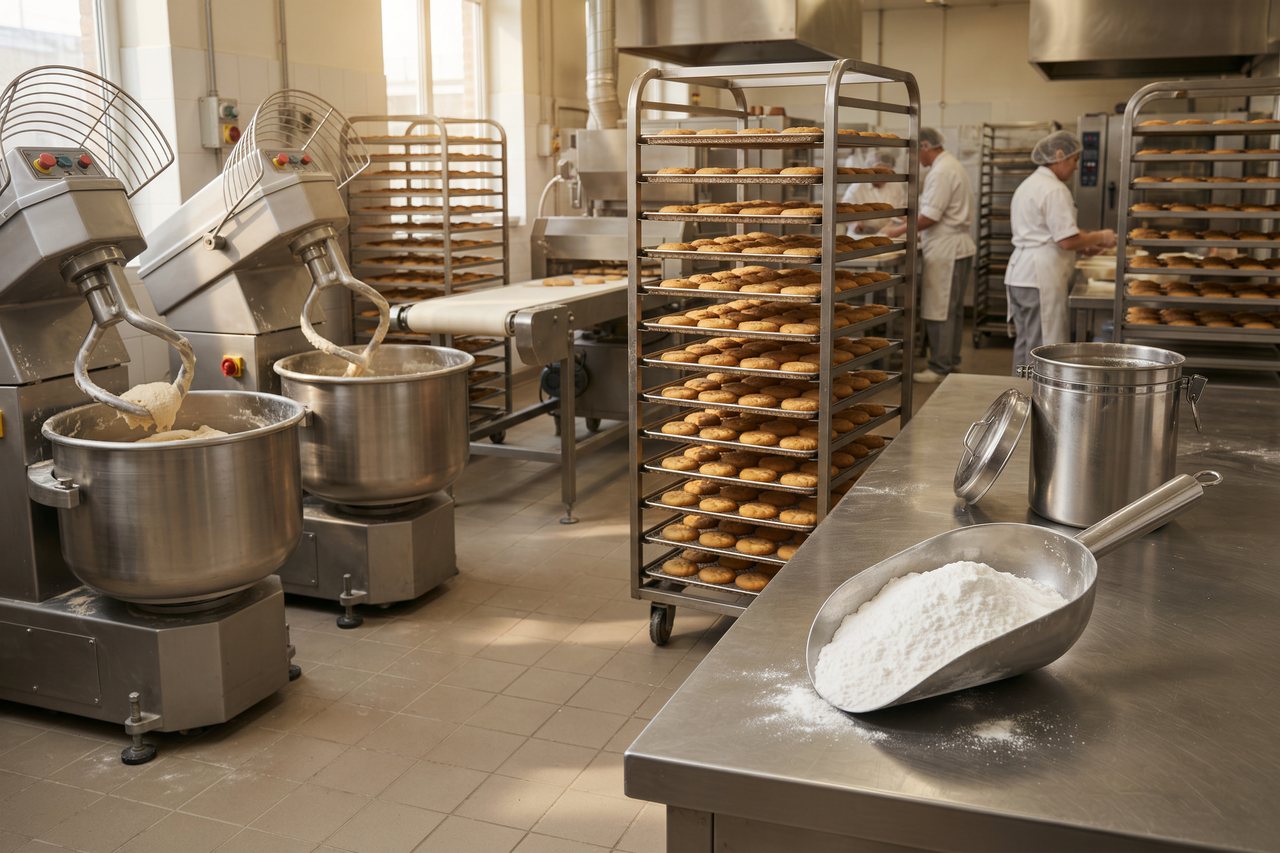
Authorized globally under European additive code E500(ii) and U.S. FCC food monographs, Food Grade sodium bicarbonate performs far more than simple dough leavening. Industrial food plants rely on controlled NaHCO3 purity to regulate Maillard crust coloration, calibrate beverage pH, soften legumes, preserve green vegetable chlorophyll, and standardize cocoa powder alkalization.
By itself, sodium bicarbonate begins reacting immediately upon contact with acidic dough ingredients—yogurt, buttermilk, molasses, or honey—and decomposes thermally above 65–80 °C to liberate gaseous CO2. Commercial baking-powder formulators blend roughly 28–32% fine-grade NaHCO3 with staged food acids (such as monocalcium phosphate for bench rise and SAPP or sodium aluminum phosphate for oven spring) plus cornstarch moisture buffers.
Controlling crystal granulometry directly dictates CO2 release timing: ultra-fine powders dissolve rapidly in high-moisture batter, whereas slightly coarser grades resist premature bench reaction in refrigerated biscuit doughs. Compare sieve specifications on our Sodium Bicarbonate Datasheet and Granular vs Fine Particle Review.
Elevated surface pH accelerates non-enzymatic Maillard browning between reducing sugars and amino acids, which is why commercial pretzel lines dip dough in dilute alkali baths and cookie manufacturers dial NaHCO3 ratios carefully to adjust spread, crispness, and golden color.
In chocolate processing, controlled alkalizing ("Dutching") of cocoa nibs with food-grade bicarbonate neutralizes native acetic acids, deepening color from reddish-brown toward mahogany or dark onyx while rounding bitter notes. Separately, food canneries add small controlled doses to blanching water to exchange magnesium-bound pectins in dried beans and peas, reducing thermal cook times cleanly without mushiness.
Beverage bottlers and reverse-osmosis (RO) drinking water plants inject pure food-grade NaHCO3 downstream of membranes to stabilize bicarbonate alkalinity, eliminate aggressive low-pH pipe corrosion, and balance sensory taste profiles. Every batch entering food factories requires strict USP/FCC conformance: >= 99.0% assay, negligible heavy metals (<= 5 ppm Pb), allergen-free certification, and sealed hygienic 25 kg packaging.
Stoichiometric gas yield depends on reliable bicarbonate purity; thermal conversion to Na2CO3 creates soapy off-flavors and erratic crumb structure.
Fine grades disperse homogeneously into beverage concentrates and sponge batters; medium meshes resist caking inside dry cake pre-mixes.
Raising dough alkalinity by 0.3–0.6 pH units accelerates golden caramelization and lateral spread across industrial tunnel ovens.
Full batch COAs, allergen-free statements, and micro-testing clear incoming food-safety audits (HACCP / ISO 22000).
Review technical files and related articles for bakery and food-manufacturing buyers:
Industrial Supply
November 26, 2026
Industrial Supply
November 26, 2026
Industrial Supply
November 22, 2026
Practical chemical specifications, bulk packaging protocols, and commodity supply insights from Beroil Energy Group.

Product Science
November 22, 2026
Global Markets
November 22, 2026
Industrial Supply
November 22, 2026