Language
LanguageEnglish
Industrial Supply
November 26, 2026 · 12 min read
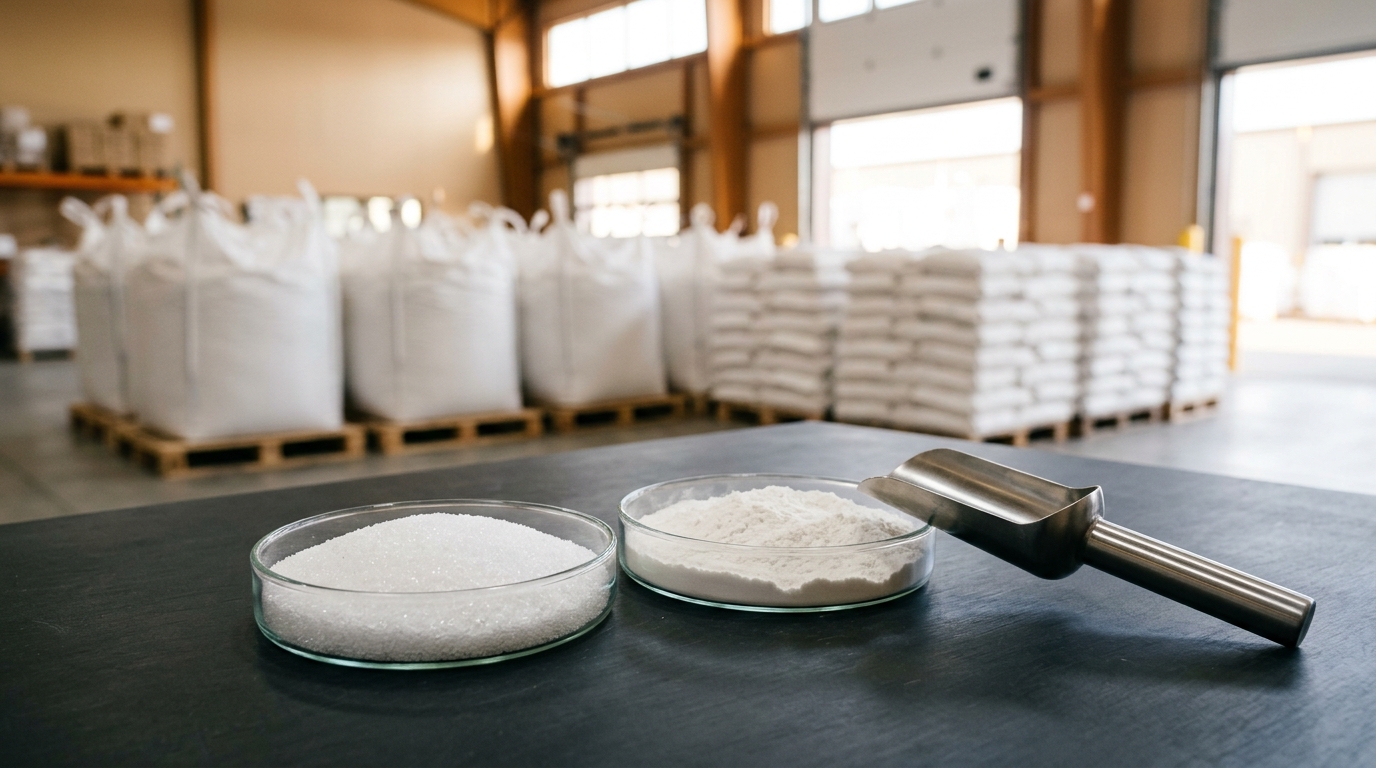
Although Dense Soda Ash and Light Soda Ash share the exact same chemical identity—anhydrous sodium carbonate (Na2CO3, 99.2% min, CAS 497-19-8, HS 2836.20)—their bulk density, particle geometry, and container loading economics behave completely differently across glass furnaces, detergent towers, and ocean freight lanes. Ordering the wrong physical grade can inflate per-ton 20ft container shipping costs by up to 30%, trigger dust losses in glass regenerators, or cause severe moisture caking before cargo reaches your plant.
On paper, Soda Ash Light and Dense grades (Na2CO3, 99.2% min) look virtually identical: both target >= 99.2% total alkalinity as Na2CO3, chlorides <= 0.70% (as NaCl), iron <= 0.0035% (as Fe2O3), and water-insoluble matter <= 0.04%. In wet chemical dissolution tanks, both dissolve to form strongly alkaline solutions (pH 11.4 at 1% concentration, 25°C). Yet in dry-handling hoppers, silos, and shipping containers, they are two distinct industrial products.
Roughly 70% of world output comes from the synthetic Solvay ammonia-soda process, in which calcining precipitated sodium bicarbonate at 300°C yields fine powdery Light Soda Ash (loose bulk density 500–650 kg/m3). To make Dense Soda Ash (950–1,100 kg/m3), manufacturers hydrate Light Soda Ash into sodium carbonate monohydrate crystals (Na2CO3·H2O) and re-calcine them into coarse, free-flowing anhydrous granules. The remaining ~30% comes from natural trona ore and alkaline brines—such as Turkish Beypazarı/Kazan and US Wyoming deposits—which naturally refine at ultra-low chloride levels (typically 0.02%–0.10% NaCl vs. 0.25%–0.70% in Solvay material).
Procurement desks monitoring daily parity across live Soda Ash export pricing benchmarks should also note the closed chemical loop between soda ash and commercial Sodium Bicarbonate (NaHCO3), since purified sodium carbonate liquor carbonated with CO2 feeds technical, feed, and E500 food-grade baking soda lines.
Glass manufacturing absorbs roughly 48% of global soda ash consumption across flat architectural glass, automotive windshields, container bottles, and fiberglass—and glassmakers mandate Soda Ash Dense almost without exception. Coarse 150–600 µm Dense granules match silica sand sizing to eliminate batch segregation inside storage silos, minimize airborne alkali dust losses inside high-velocity 1,500°C melting furnaces (which otherwise foul regenerator checker brick), and require strictly capped iron oxide (Fe2O3 <= 0.0035% / 35 ppm) so clear flint and float glass stay free of green tinting. Dense grade also dominates sodium silicate (water glass) furnaces, pig-iron desulfurization, and battery-grade lithium carbonate extraction.
By contrast, Soda Ash Light (500–650 kg/m3, fine crystalline ~75–200 µm powder) is engineered for ~10% of world demand in soaps and phosphate-free laundry powders, alongside chemical synthesis (~26%), textile reactive dyeing, pulp bleaching, and municipal pH control. Its fluffy, porous crystal lattice provides massive surface area to absorb liquid surfactants (such as LABSA and non-ionics) inside dry detergent blenders without turning soggy, while dissolving almost instantaneously in cold or lukewarm process tanks.
Practical buyer rule: when you only dissolve soda ash into liquid brine tanks (water treatment, pulp mills, chemical pH buffering), switching from Light to Dense often lowers your delivered CFR cost per ton without altering reaction chemistry; conversely, dry-mix detergent blenders cannot swap in Dense granules, and plants needing stronger hydroxide alkalinity step up to Caustic Soda (NaOH) 99% Flakes & Pearls.
The single biggest blind spot in seaborne Soda Ash importing is container payload efficiency. A standard 20 ft dry shipping container offers ~33.2 m3 internal cubic volume and ~28 MT max cargo payload. Because Dense Soda Ash packs at 950–1,100 kg/m3, exporters cleanly stuff 24 to 26 MT inside every 20ft FCL (typically 20 × 1,250 kg FIBC jumbo bags, 24 × 1,000 kg FIBC bags, or 500 × 50 kg bags). Light Soda Ash, however, sits at 500–650 kg/m3 and hits physical cubic volume capacity around 18 to 21 MT per 20ft FCL (360–420 × 50 kg bags or 18–20 × 1 MT jumbo bags). Because ocean carriers charge per container box rather than per ton, Light grade automatically carries a 20%–35% higher sea-freight penalty per metric ton than Dense.
Equally critical is moisture barrier protection. Anhydrous Na2CO3 is strongly hygroscopic: when exposed to humid tropical air or container "sweat" condensation during 15–35 day ocean transits, exposed granules hydrate on the surface into rock-hard Na2CO3·H2O crusts ("tombstoning") that jam automated screw feeders. Reliable export packing therefore mandates woven polypropylene (WPP) outer bags fitted with heat-sealed or tie-closed polyethylene (PE) inner moisture liners (minimum 50–70 µm liner inside 100+ gsm WPP fabric), stacked on dry wooden dunnage with container silica/calcium-chloride desiccant strips, and palletized + shrink-wrapped whenever destination yards use forklifts.
Through Beroil Energy Group—covering SACHI Soda Ash and multi-origin container allocations starting at a 50 MT minimum order—buyers can choose 25 kg or 50 kg PE-lined PP bags (ideal for detergent formulators and wholesale distribution), UV-stabilized 1,000 kg or 1,250 kg FIBC jumbo bags with 5:1 / 6:1 lifting loops, or neutral export branding matching local customs rules. Detailed humidity precautions parallel our bulk sodium bicarbonate moisture-control warehousing standards.
Never clear an import L/C or TT balance on a vague commercial invoice saying only "Soda Ash 99%." Demand full ISO batch testing on the loading-port Certificate of Analysis: ISO 740 Total Alkalinity (>= 99.2% Na2CO3; top-tier batches hit 99.4%+), ISO 742 Chlorides as NaCl (<= 0.70% max—verify <= 0.10%–0.20% if feeding corrosion-sensitive stainless boilers or high-clarity glass), ISO 744 Iron as Fe2O3 (<= 0.0035% max), ISO 746 Water-Insoluble Matter (<= 0.04% max—prevents dosing nozzle fouling), ISO 903 Loose Bulk Density confirming true Dense vs. Light spec, and especially ISO 745 Loss on Ignition at 250°C (<= 0.50% max). An elevated LOI reading above 0.8%–1.0% immediately flags aged warehouse stock that has already absorbed ambient water or atmospheric CO2.
Logistics advantage for importers: under HS Code 2836.20, Sodium Carbonate is Non-Hazardous and Not Regulated as Dangerous Goods under the IMDG Maritime Code—avoiding the IMO Class 4.1 documentation hurdles of elemental Sulfur (UN 1350) and the IMDG Class 8 corrosive surcharges required for Caustic Soda (UN 1823). Shipments still require a compliant GHS07 Eye Irritant Safety Data Sheet (SDS), Chamber of Commerce Certificate of Origin, weight/packing list, and independent SGS or Intertek composite manifold sampling at load port with bolt-seal numbers logged directly on the Bill of Lading.
Understanding origin economics helps industrial buyers time quarterly contracts. European and Asian synthetic Solvay plants are heavily sensitive to coking coal, limestone, ammonia, and natural gas tariffs, whereas natural trona hubs (such as Turkey and the US) enjoy structurally lower thermal energy intensity and ultra-low chloride assays. Regional seaborne pricing then flexes around Chinese flat-glass production cycles, East/West Africa container equipment availability, and Red Sea routing surcharges.
Smart regional importers stabilize supply by cross-tracking daily export parity on our Soda Ash Market Intelligence terminal, consolidating container slots across our multi-commodity petrochemical and alkali catalog alongside Sodium Bicarbonate and Caustic Soda, and requesting port-specific CFR quotes directly through our commercial trade quotation desk with exact grade (Dense/Light), bag size (25 kg / 50 kg / 1 MT FIBC), tonnage, and destination port.
Soda Ash Dense packs at 950–1,100 kg/m3 as coarse 150–600 µm free-flowing granules; Soda Ash Light sits at 500–650 kg/m3 as fine 75–200 µm crystalline powder.
Both ship at >= 99.2% Na2CO3 (ISO 740), <= 0.70% NaCl (ISO 742, natural trona often <= 0.10%), <= 0.0035% Fe2O3 (ISO 744), <= 0.04% insolubles (ISO 746), and <= 0.50% LOI at 250°C (ISO 745).
Dense maxes container weight efficiently at 24–26 MT per 20ft FCL; Light cubes out at 18–21 MT per 20ft FCL—raising per-ton ocean freight cost by ~20%–35% on container lanes.
Dense serves float/container glass furnaces, sodium silicate, and metallurgy without flue dust loss; Light excels in detergent powder surfactant absorption, reactive dyeing, and rapid dissolution.
HS 2836.20 ships Non-Hazardous (non-IMDG) in PE-lined 25/50 kg WPP bags or 1 MT / 1.25 MT FIBC jumbo bags (MOQ 50 MT) with desiccants and SGS/Intertek load-port COA.
Access technical datasheets, live export pricing, and consolidated alkali supply across Beroil Energy Group:
Both share the exact same chemical formula (Na2CO3 >= 99.2% min), but Dense Soda Ash has coarse 150–600 µm granules (950–1,100 kg/m3) engineered for dust-free glass furnaces and 24–26 MT/20ft container efficiency, whereas Light Soda Ash is a fine 75–200 µm powder (500–650 kg/m3) that dissolves quickly and absorbs liquid surfactants cleanly in powder detergents.
If your plant completely dissolves soda ash into an aqueous tank (for water treatment, pH adjustment, pulp processing, or chemical wet reaction), switching to Dense typically saves 20%–35% on container freight per ton (25 MT vs. 19 MT per 20ft FCL) with identical alkaline chemistry. However, for dry-blended laundry detergents or oil/surfactant absorption, Light grade remains essential.
Anhydrous sodium carbonate absorbs ambient humidity and CO2 over time. Measuring Loss on Ignition at 250°C (capped at <= 0.50% max under ISO 745) immediately reveals whether cargo is freshly produced and dry—protecting buyers against hydrated, hardened lumps before containers leave the loading port.
No. Under HS Code 2836.20, Sodium Carbonate (Light and Dense) is Non-Hazardous and not regulated under IMDG maritime dangerous goods rules—meaning it ships in standard dry 20ft containers without IMO Class 8 or Class 4.1 DG freight surcharges, accompanied by a standard GHS07 Eye Irritant SDS.
Beroil Energy Group supplies both Light and Dense grades—including SACHI Soda Ash allocations—starting from a 50 MT minimum order in PE-lined 25 kg or 50 kg woven PP bags and UV-stabilized 1,000 kg / 1,250 kg FIBC jumbo bags (loose or palletized/shrink-wrapped) with full SGS load-port inspection under FOB, CPT, or CFR ASWP terms.
Industrial Supply
November 26, 2026
Industrial Supply
November 22, 2026
Product Science
November 22, 2026
Practical chemical specifications, bulk packaging protocols, and commodity supply insights from Beroil Energy Group.
Global Markets
November 22, 2026
Industrial Supply
November 22, 2026
Technical Research
November 22, 2026