Beroil Energy
Beroil Energy
Language
LanguageEnglish
Home
About
Products
Insights
Blog
Contact

Stay Connected with Beroil

Quick Link

HomeAboutProductsInsightsBlogContact

Contact Info

info@beroilenergy.com+44 744 913 9023

4-6 Middlesex St., E1 7JH, London, United Kingdom

BEROIL

Copyright © 2026 Beroil Energy Group. All Rights Reserved

  • Terms of Service
  • Privacy Policy
Chat on WhatsApp

Articles & Market Insights

HomeBlogProduct Science

Product Science

|

September 1, 2023 · 5 min read

Sodium Bicarbonate in Commercial & Eco-Safe Cleaning: Gentle Abrasion and Mild Alkalinity

Beroil Trade Desk

Commercial food-safe sanitation and non-corrosive degreasing with sodium bicarbonate

Across commercial food plants, hospitality kitchens, and green detergent blenders, sodium bicarbonate replaces toxic solvent degreasers and volatile chlorine wipes on day-to-day maintenance lines. Its rare pairing of zero VOC toxicity, water solubility, Mohs 2.5 scratch resistance, and buffered pH 8.3 mild alkalinity clears grease and film safely where aggressive caustics corrode fixtures.

Three Cleaning Mechanisms Working Simultaneously

First, as an aqueous alkaline salt, dissolved NaHCO3 ionizes fats and oils gently into emulsifiable soap salts without attacking hands or lacquer as high-pH Caustic Soda does. Second, fine solid crystals deliver controlled mechanical shear at Mohs 2.5 hardness—strong enough to dislodge baked oven carbon or ceramic sink rings without scoring brushed stainless steel or vitreous porcelain.

Third, bicarbonate binds acidic volatile compounds chemically rather than perfuming workspaces, leaving stainless food prep tables odorless and rinse-free of persistent surfactants.

Where Mild Bicarbonate Ends—and Heavy Alkali Builders Take Over

Professional formulators know precise strength limits: for light facility sanitation, food-plant washdowns, and carpet deodorizing, Sodium Bicarbonate is unmatched in operator safety. Yet for extreme petroleum CIP bottle washing, heavy saponification vats, and high-alkalinity industrial laundries, detergent plants step upward cleanly to Light Soda Ash (pH 11.4) or liquid/flake Caustic Soda 99% (pH 13–14).

4 Operational Benefits Over Harsh Chemical Cleaners

01.

Zero VOC Vapor & Chlorine Fume Risk

Safe around closed food-processing spaces and staff without corrosive respiratory misting (note: still avoid mixing directly with bleach or strong acids unnecessarily).

02.

Scratch-Safe on Stainless, Ceramic & Glass

Crystals crush laterally around Mohs 2.5 before scratching industrial steel alloys or glazed tilework.

03.

Effluent-Friendly Neutralization

Biocompatible sodium and bicarbonate ions break down cleanly in municipal drains without phosphate eutrophication.

04.

Low-Cost Single-Ingredient Versatility

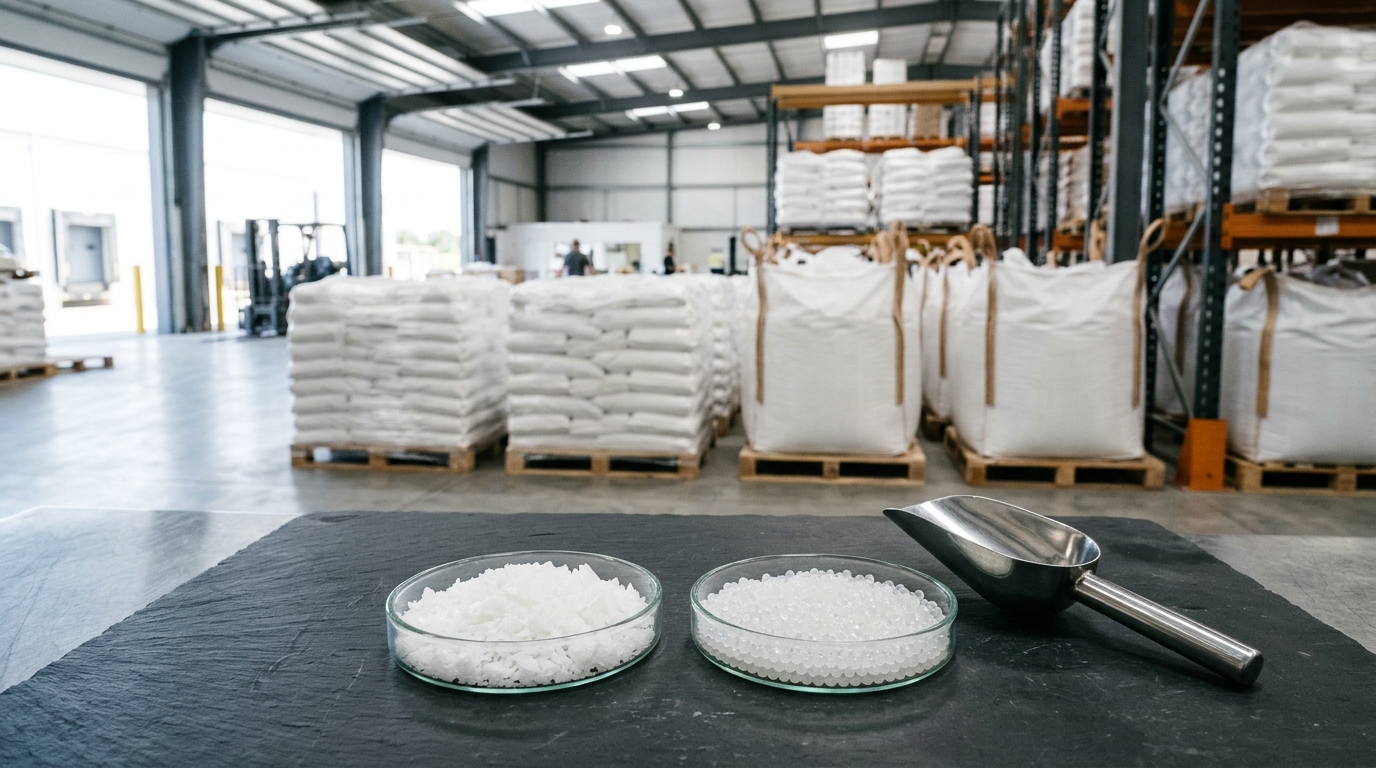
Replaces separate abrasive pastes, odor absorbers, and mild alkaline rinses out of a single 25 kg bag.

Cleaning Chemistry Guides & Alkali Options

Match cleaning intensity to exact pH requirements:
  • Carpet & Upholstery Deodorizing Guide: Practical fiber safety and vacuum steps for fine NaHCO3.
  • Light Soda Ash (Detergent Builder): Phosphate-free water softening & laundry powder base (99.2% Na2CO3).
  • Caustic Soda 99% (Heavy CIP Degreasing): Strong industrial chlor-alkali base for refinery & bottle-wash CIP lines.
  • Request Cleaning Formulation Supply: Inquire on 25 kg & 1 MT bulk container orders with Beroil.

Related Specifications & Further Reading

  • Carpet Deodorizing & Textile Safety Guide
  • Soda Ash (Na2CO3) for Detergent Formulators

Beroil Trade Desk

Petrochemical & Technical Research

Category

Technical Research

05

Packaging & Logistics

02

Industrial Supply

10

Product Science

09

Global Markets

06

Latest Posts

Caustic Soda Flakes 99% vs. Pearls vs. 50% Liquid (NaOH): Specs, IMDG Class 8 & Export Import Guide

Industrial Supply

|

November 26, 2026

Caustic Soda Flakes 99% vs. Pearls vs. 50% Liquid (NaOH): Specs, IMDG Class 8 & Export Import Guide

Soda Ash Dense vs. Light (Na2CO3 99.2%): Specs, Export Packing, Moisture Control & B2B Import Guide

Industrial Supply

|

November 26, 2026

Soda Ash Dense vs. Light (Na2CO3 99.2%): Specs, Export Packing, Moisture Control & B2B Import Guide

Granular vs. Lump vs. Powder Sulfur: Industrial Uses, Technical Specs & Commercial Export Guide

Industrial Supply

|

November 22, 2026

Granular vs. Lump vs. Powder Sulfur: Industrial Uses, Technical Specs & Commercial Export Guide

Recent Posts

Practical chemical specifications, bulk packaging protocols, and commodity supply insights from Beroil Energy Group.

Polymer Modified Bitumen (PMB) & Bitumen Emulsions (CRS-2, CSS-1): Heavy-Axle & Cold Paving Engineering

Product Science

|

November 22, 2026

Polymer Modified Bitumen (PMB) & Bitumen Emulsions (CRS-2, CSS-1): Heavy-Axle & Cold Paving Engineering

How to Audit a Bitumen COA & SGS Report: ASTM D5, D36, Spot Test & B2B Export Procurement Checklist

Global Markets

|

November 22, 2026

How to Audit a Bitumen COA & SGS Report: ASTM D5, D36, Spot Test & B2B Export Procurement Checklist

Oxidized Bitumen 115/15 and 90/15: Softening Point Engineering for Waterproofing, Roofing & Pipe Coating

Industrial Supply

|

November 22, 2026

Oxidized Bitumen 115/15 and 90/15: Softening Point Engineering for Waterproofing, Roofing & Pipe Coating